With the upcoming AI agent economy, will the new whitepaper clearly define GLMR’s mandatory role in the protocol? For example, will AI agents need to use or stake GLMR for identity, reputation, coordination, settlement, or security, or could the protocol function entirely with ETH/USDC on Base?
Thanks! I’m glad to hear I’m not the only one wondering about this.
After digging into the migration and ACP, I actually think the long-term vision is more compelling than simply remaining a Kusama parachain.
The opportunity around AI agent infrastructure appears much larger, but I think the key question for all of us as holders is how MOVR captures value if ACP succeeds.
Hopefully the team can provide more clarity on the token’s role, economics, and long-term roadmap.
I think those answers will help everyone better understand the investment thesis going forward
2 Likes
Hello,
The migration page is not working at all!
I can’t connect my wallet. The system says “Injected” every single time, and I can’t migrate my tokens:(
Hello, looks very browser-connector specific. We’ll look into, meanwhile please try using different browser / wallet combination.
I did it through my wallet browser. Thank you
But I can’t see my tokens in my wallet yet! I did the migration over 1 hour ago.
Please, can you tell where to see them?
With all due respect, this didn’t answer any of my concerns, and not one by one. I am still getting in contact with stakers to the CertHum collator. And they are basically out of time if they don’t unstake in the next day.
“On “known value to completely unknown”: This is not a swap into a new asset, it’s the same GLMR, 1:1, at the same address. The value doesn’t come from this page or from us, it moves with the asset.”
GLMR underpinned and had value associated with the Moonbeam blockchain. The value does not simply move. This is a fundamental change in what the asset backs. There is still, one week from migration, no clarity on what the future of GLMR will be, and what value it will hold post migration.
“We’re a team with years of hands-on background across AI, smart contracts, and Polkadot parachain engineering” - this really tells nothing. Where did you work? What teams did you support? What successes did you have? If you need help, look back in the forum to the treasury and ecosystem grants applications. Those tell a background, but what you gave is a non-answer.
I sadly was invested in the Enigma ENG to Secret SCRT token swap. They gave about 6 months of a window to swap. And still, years after, people came and asked why their tokens were lost. You are giving one month. Do you really think this is a good idea? People buy tokens and disappear for years, because they see it as a long term holding.
I truly wish you the best of luck in the new endeavor. But something to consider. You are inheriting all of the good will which Moonbeam grew for six years. You own that now. Do it justice, and spend it wisely.
4 Likes
On Base, the entire GLMR total supply from Moonbeam has already been minted. This suggests that no additional minting is required after the migration. If that’s the case, then any unclaimed GLMR could simply remain locked in a claim contract and be released later to the rightful owner based on the snapshot. If Moonbeam is shutting down completely, this seems like the only way to allow claims after July 31 without relying on the original chain. Could the team clarify whether unclaimed GLMR will remain locked on Base until claimed, and whether those tokens will be counted as circulating or non-circulating supply?
@SvPatrik @venomousz
I revoked my tokens from staking and my tokens are reserved now. I get this message: Revoke executable in 6 days 23 hrs. Can I access my tokens only after the bridging deadline??
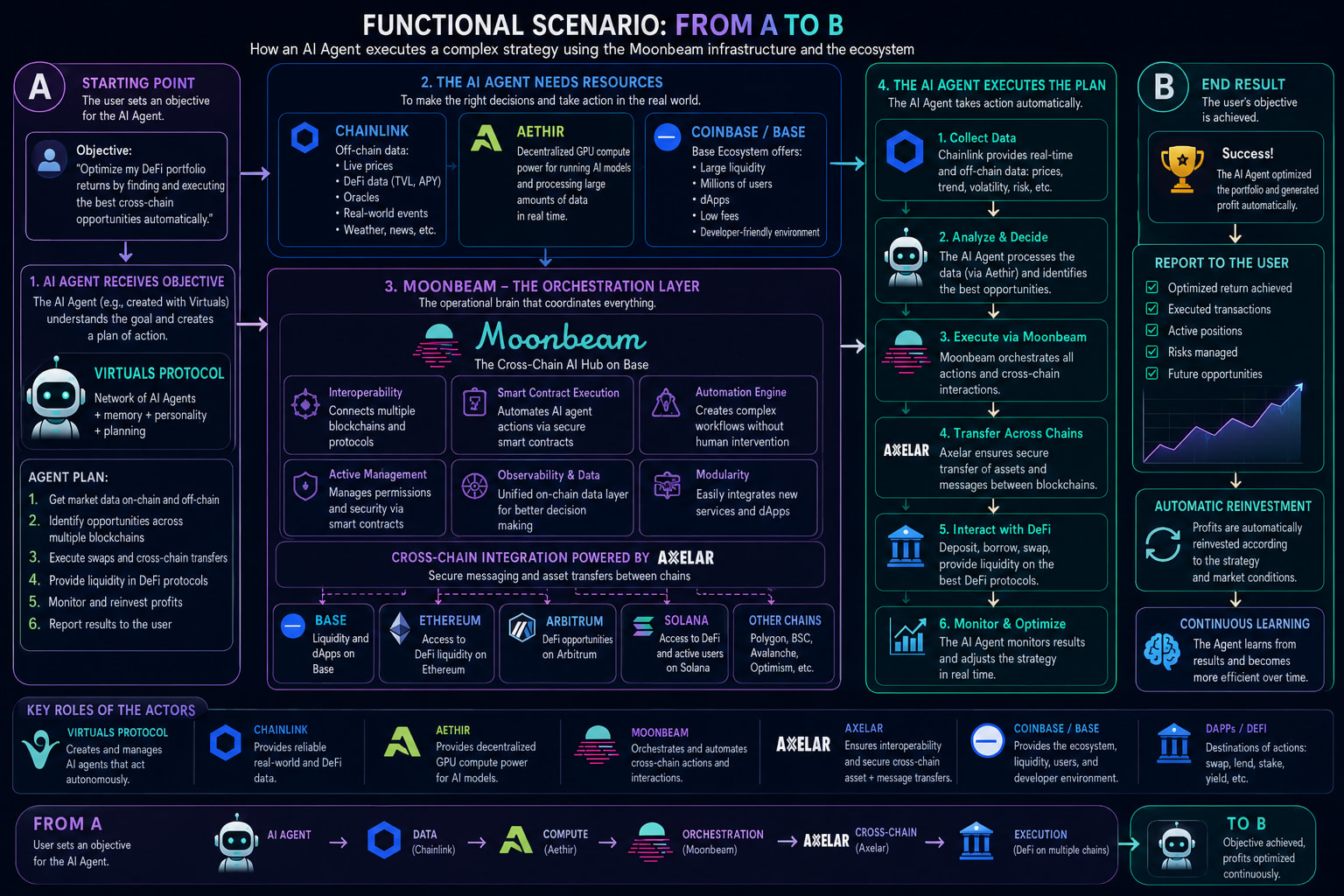
After studying Moonbeam’s new AI strategy, I’ve been thinking about what comes next after July 31st.
The migration to Base is an important milestone, but in my opinion, it is only the foundation.
If Moonbeam truly aims to become the AI Hub on Base, I believe the next step must be real ecosystem partnerships.
An AI ecosystem cannot thrive in isolation. It requires collaboration between multiple infrastructure providers and specialized projects.
For example:
• AI agent platforms (such as Virtuals)
• Data and oracle infrastructure (such as Chainlink)
• Decentralized compute providers (such as Aethir)
• Cross-chain messaging and interoperability (such as Axelar)
• The Base ecosystem itself
• Leading DeFi protocols where AI agents can actually execute strategies
These are the kinds of integrations and partnerships I hope to see announced after July 31st.
Without concrete collaborations, the vision of Moonbeam becoming an AI Hub would remain just that—a vision. With them, however, Moonbeam could become the orchestration layer that connects AI agents, data, compute, interoperability, and DeFi into a unified ecosystem.
I’m optimistic, and I hope the team has been building these relationships behind the scenes. The weeks following July 31st will be very important in demonstrating how this strategy will be executed.
A proposal for protecting Moonbeam-native projects and community members affected by the migration
StellaSwap is not just another application deployed on Moonbeam. It is one of the fundamental infrastructure projects of the original Moonbeam DeFi ecosystem.
For years, StellaSwap provided liquidity, trading infrastructure, and user activity that helped build the Moonbeam ecosystem. Many users, liquidity providers, and investors supported Moonbeam because of the ecosystem that was created around it — including native projects such as StellaSwap.
The decision to migrate Moonbeam to Base may be a strategic move for the future, but we should acknowledge that this transition creates significant consequences for existing Moonbeam-native projects and their communities.
Projects like StellaSwap built their value specifically around Moonbeam. The reduction of activity, liquidity migration, and uncertainty around the old ecosystem directly affects these projects and their token holders.
This is not a question of market price speculation. The issue is the loss of ecosystem value created through years of contribution, development, and community support.
I believe Moonbeam should consider creating a dedicated Ecosystem Recovery Fund for affected Moonbeam-native projects.
Such a fund could support:
-
Moonbeam-native protocols that lose ecosystem value during the transition;
-
communities and token holders affected by the migration;
-
liquidity restoration and migration incentives;
-
projects that helped build Moonbeam from the beginning.
The compensation should not be based only on the current market price of tokens, because the damage is not caused by normal market volatility. It is a structural change of the ecosystem where these projects were created and operated.
Supporting projects like StellaSwap would demonstrate that Moonbeam values the teams and communities that helped build the network. A successful migration should not mean leaving behind the ecosystem that made Moonbeam possible.
I hope the Moonbeam team will consider a fair recovery mechanism that protects long-term contributors and preserves trust in the ecosystem.
Hello again
Please help me with this!! I’m not technical at all!
I did migrate my tokens 4 days ago and still can’t see them in my Trust Wallet?
The system said that the migration was successfully and I will see the migrated token in my wallet but that’s not the case!!
A Patrik on X said that I have to synchronize my wallet manually but it ask about my private key!! So I don’t trust this?? Please help
You need to manually add GLMR from the Base network to see your tokens.
Please tell how to do that? Sorry for my very bad technical skills
Ask here
Bro, so what! Did Moonbeam demand money from DOT, who changed its ecosystem around parachains? No, of course not; they pivoted! Just because Stella built its business around Moonbeam doesn’t mean they owe Stellaswap anything! Each project needs to stand on its own merit and find ways to succeed as a project. This is probably why Moonbeam and Moonriver left DOT; they changed the entire central narrative around Parachains and left Parachains to fend for themselves. I don’t blame Moonbeam and Moonriver for saying screw DOT; let’s move to Base and do our own thing, This was a coherent plan DOT is falling behind as a network. The DOT community is filled with negativity; I would leave too!
1 Like
Hey, to add the new GLRM and MOVR tokens to wallets, we’ve prepared helpful one-click buttons. Please go to the official portal migrate.portal.moonbeam.network and see the “verify” section. 4x buttons should be right there.
Unstaking alone takes 6 days and this was announced on the 3rd of July. Effectively there are only 21 days to react to the migration. Why is the dead line so short? Why can` you not push back the deadline at least to end of August? I started unstaking today and I can not bridge my glmr. What can I do in this case?
There will be snapshots.You will not loose your Glmr.Wait for future info about this.
1 Like
Let me put it simply. If the migration to Base hadn’t happened, the exchange rate would have stayed normal, and I would have been able to manage my funds properly. I don’t blame Moonbeam for Stella’s poor price performance, but they are responsible for the fact that the Stella pool is shutting down.
You’re mixing up cause and responsibility. Stella’s problems didn’t begin with the Base migration. Stella had already publicly acknowledged financial difficulties, declining activity, and shrinking revenue well before this announcement. They even sought financial support because the business wasn’t sustainable.
If Stella had been a healthy, growing protocol, a migration wouldn’t automatically mean shutdown. They could have migrated, pivoted, or continued building. Instead, they chose to wind down because their business was already in a weak position.
Blaming Moonbeam for Stella shutting down is like blaming a landlord because a struggling restaurant closes after its lease expires. The lease ending may be the final event, but it wasn’t the reason the restaurant was failing.
Every crypto project has to stand on its own. Moonbeam wasn’t obligated to remain on an ecosystem forever to prop up a protocol that was already struggling. They made a strategic decision based on what they believe gives the project the best long-term future. Stella was responsible for adapting to that reality—or not.
Stella’s financial condition and business decisions are Stella’s responsibility. The migration may have exposed those weaknesses, but it didn’t create them.
1 Like